Apollo Astronaut Schmitt on Moon Landing and the Search for Life
Apollo 17 astronaut Harrison Schmitt discusses the lunar missions, the experience of walking on the moon, and his perspectives on the possibility of life beyond Earth.
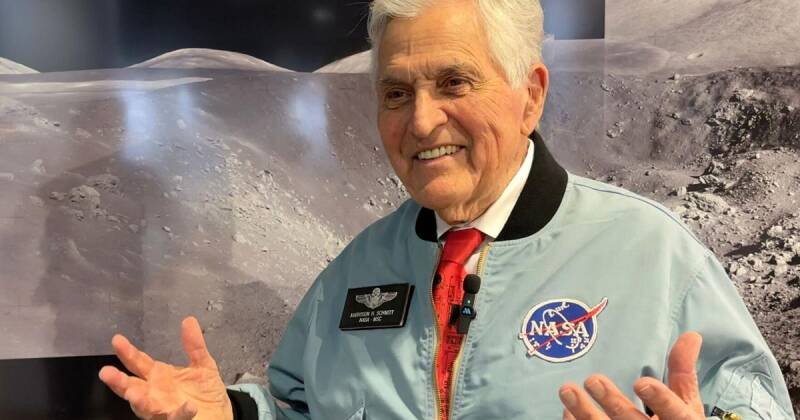



Apollo 17 astronaut Harrison Schmitt discusses the lunar missions, the experience of walking on the moon, and his perspectives on the possibility of life beyond Earth.
Harrison Schmitt, one of only four living individuals who walked on the moon during NASA's Apollo program, recently shared his reflections on the groundbreaking lunar missions and his thoughts on the enduring question of life beyond Earth. His unique perspective, gained from personal experience on the lunar surface, provides valuable insights into humanity's ongoing quest to understand our place in the cosmos.
Schmitt was part of the Apollo 17 mission in 1972, the last time humans walked on the moon. He recalls the awe-inspiring experience of exploring the lunar landscape, collecting rock and soil samples, and conducting scientific experiments. These missions were pivotal in expanding our knowledge of the moon's geology, history, and potential resources. He often speaks about the stark beauty and silence of the lunar environment.
The experiences of Apollo astronauts like Schmitt are invaluable. They provide a unique human perspective on space exploration, reminding us of the courage and ingenuity required to push the boundaries of human achievement.
Schmitt's reflections are more than just historical anecdotes. They serve as a powerful reminder of what humanity can achieve when driven by curiosity and a desire to explore the unknown. At a time when space exploration is experiencing a resurgence with both government and private initiatives, his insights offer both inspiration and guidance. His words highlight the continued importance of space exploration, not just for scientific discovery, but also for technological advancement and fostering international collaboration.
The continued interest in the Apollo missions, decades after their completion, demonstrates the enduring power of human achievement and the human desire for exploration. Schmitt's insights offer a crucial link to this legacy, reminding us of the capabilities we once possessed and the potential we still hold. The lessons learned during the Apollo era, in terms of engineering, scientific research, and mission management, continue to influence current and future space exploration endeavors. Furthermore, his perspective on the possibility of extraterrestrial life encourages a broader discussion about our place in the universe and the potential for discovering other life forms.
The Apollo program was a landmark achievement in human history. It not only demonstrated our ability to travel to another celestial body but also sparked a generation's interest in science, technology, engineering, and mathematics (STEM) fields. We see this legacy continuing to inspire young people to pursue careers in space exploration and related fields.
With renewed interest in lunar exploration, spearheaded by NASA's Artemis program and various private companies, Schmitt's experiences become even more relevant. As humanity prepares to return to the moon and eventually venture to Mars, the lessons learned from the Apollo missions will be invaluable. His insights can inform the design of future missions, the training of astronauts, and the strategies for conducting scientific research on other celestial bodies.
The question of life beyond Earth is also driving much of the current space exploration effort. The search for biosignatures on Mars, the exploration of ocean worlds like Europa and Enceladus, and the development of advanced telescopes to search for exoplanets are all aimed at answering this fundamental question. Astronauts like Schmitt, having witnessed the vastness of space and the unique conditions on other planets, provide valuable perspectives on this endeavor.
In our opinion, the perspectives of astronauts like Harrison Schmitt are essential for guiding the next generation of space explorers. This could impact public opinion positively toward future space missions, driving further government and private investment. We believe that listening to their experiences and incorporating their insights will significantly enhance our chances of success in future space endeavors.