Madras High Court GST Relief: Fresh Hearing Granted for Duplicate Tax Orders
The Madras High Court has ruled against multiple GST orders for the same financial year discrepancies, offering taxpayers a new hearing opportunity. Learn about the implications and future outlook.
Madras High Court Grants Taxpayers a Fresh GST Hearing, Overturning Duplicate Orders
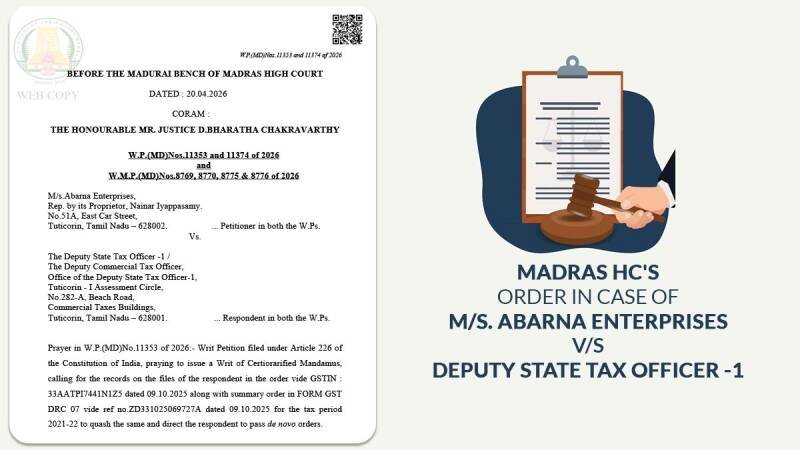
The Madurai Bench of the Madras High Court has delivered a significant win for taxpayers, ruling that issuing multiple Goods and Services Tax (GST) orders for the same issues within a single financial year (FY) is not allowed. This decision, centered around the case of M/s. Abarna Enterprises, provides welcome relief by granting affected parties a new opportunity to present their case.
The Core Issue: Duplicate GST Assessments
The heart of the matter lies in the practice of issuing separate GST orders for the same discrepancies observed within a particular financial year. The court found this to be impermissible, highlighting potential issues with fairness and due process. This ruling protects businesses from being penalized multiple times for what is essentially the same alleged tax violation.
The Case of M/s. Abarna Enterprises
While the specific details of M/s. Abarna Enterprises' case are not fully outlined in the source news, it served as the catalyst for this important ruling. The court's decision to grant a fresh hearing indicates that the initial orders were deemed flawed, potentially due to the duplication of assessments.
Why This News Matters
This ruling is more than just a procedural victory. It reinforces the principles of fairness and consistency in tax administration. By preventing the issuance of duplicate orders, the Madras High Court protects taxpayers from potential harassment and unnecessary financial burden. This also encourages a more streamlined and efficient GST assessment process. The decision ultimately promotes greater transparency and trust between tax authorities and businesses.
Our Analysis
In our opinion, the Madras High Court's decision is a welcome clarification of existing GST regulations. The potential for multiple assessments for the same issue created a significant burden on businesses, especially smaller enterprises lacking extensive resources to navigate complex legal challenges. This ruling addresses a systemic issue and provides much-needed clarity.
Issuing multiple orders for the same FY issue could be interpreted as an aggressive approach by the tax authorities. By setting aside these orders, the court is signalling that fairness and proportionality are paramount in GST assessments.
Potential Challenges
While the ruling is a positive step, its practical impact depends on its consistent application. Taxpayers will need to be vigilant in identifying and challenging any instances of duplicate assessments. Similarly, the tax authorities need to ensure their internal processes prevent similar errors from recurring.
Future Outlook
This decision by the Madras High Court could potentially influence similar cases in other High Courts across India. It sets a precedent for protecting taxpayers from duplicate assessments and ensuring a fair and transparent GST process.
Impact on GST Practices
This ruling may prompt a review of existing GST assessment practices to identify and eliminate any loopholes that could lead to the issuance of duplicate orders. We believe it will encourage better training for tax officials and the implementation of robust internal controls to prevent such errors.
Future Implications
* **Reduced Litigation:** Less cases of duplicated order disputes will reduce burden on court system.
* **Increased Taxpayer Confidence:** This will increase trust in GST system.
* **Streamlined Assessments:** This forces better internal controls for the tax office.
* **Broader Adoption:** If other courts follow Madras decision, there may be a broader nationwide uniformity.
* **More Transparency**: More clarity in tax law reduces ambiguities.
This could impact how other states handle GST issues, possibly leading to more taxpayer-friendly rulings. It also highlights the importance of businesses staying informed about their rights and seeking legal counsel when facing potentially unfair tax assessments.