AI Uncertainty: Teaching AI Models to Say "I'm Not Sure"
New research tackles AI hallucinations by training models to admit uncertainty, improving reliability and potentially revolutionizing how AI is used in critical decision-making.
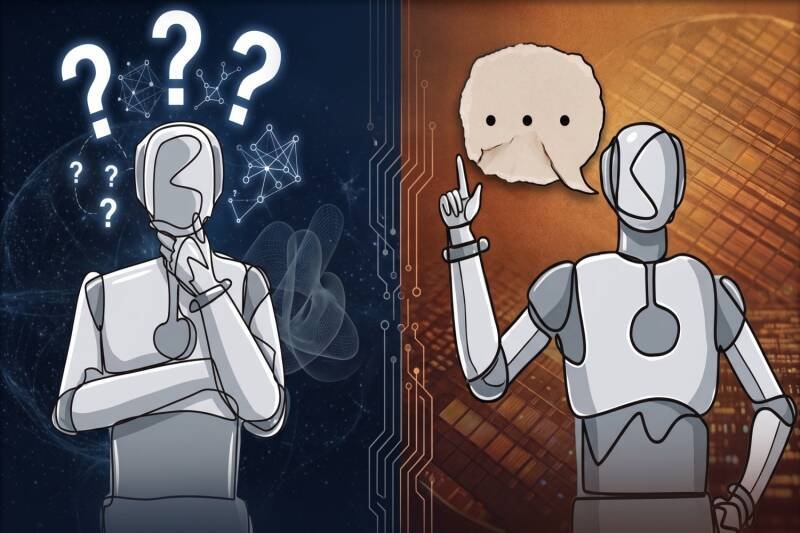



New research tackles AI hallucinations by training models to admit uncertainty, improving reliability and potentially revolutionizing how AI is used in critical decision-making.
Artificial intelligence (AI) is rapidly advancing, but it still faces a major challenge: making up information, also known as "hallucinations." Researchers are now tackling this problem head-on by developing new methods to teach AI models to recognize and express uncertainty.
AI models, especially large language models (LLMs) used for tasks like writing and answering questions, can sometimes confidently provide incorrect or fabricated information. This happens because these models are trained to always give an answer, even when they lack sufficient knowledge or evidence. The models are essentially programmed to be overly confident, which can lead to serious errors, especially in critical applications like medical diagnosis or financial analysis.
A new training method focuses on improving the reliability of AI models' confidence estimates. Instead of just rewarding correct answers, the training now also penalizes overconfidence and encourages the model to admit when it's unsure. This involves techniques that help the AI better understand the limits of its knowledge and to accurately gauge its own certainty.
The goal is not to make the AI less capable, but rather more reliable. The researchers aim to improve the accuracy of AI's self-assessment without sacrificing its overall performance on various tasks. This is a delicate balancing act.
The ability of AI to accurately assess its own confidence is crucial for its safe and effective deployment. If an AI system can honestly say "I'm not sure" when faced with ambiguous or unfamiliar data, humans can step in to provide guidance or make the final decision. This can prevent costly mistakes and build trust in AI systems.
In our opinion, this research represents a significant step forward in making AI more trustworthy and reliable. The current tendency of AI to "hallucinate" is a major obstacle to its widespread adoption, particularly in fields where accuracy is paramount.
By focusing on improving confidence estimates, the researchers are addressing a root cause of the problem. Training models to say "I'm not sure" is a pragmatic approach that acknowledges the limitations of current AI technology. This is a more nuanced approach than simply trying to eliminate all errors, which may not be feasible in the near term.
This could impact various industries. For example, imagine a medical diagnosis AI that flags when it's unsure about a patient's condition, prompting a human doctor to review the case. This would improve the accuracy of diagnoses and potentially save lives.
The future of AI likely involves a greater emphasis on transparency and explainability. As AI systems become more complex, it's essential to understand how they make decisions and to identify their potential weaknesses. Research like this is contributing to that goal.
We anticipate further advancements in techniques for measuring and communicating AI uncertainty. This will require ongoing collaboration between AI researchers, ethicists, and policymakers. Ultimately, the goal is to create AI systems that are not only powerful but also responsible and aligned with human values.
Here are some potential areas for future research:
In conclusion, teaching AI to say "I'm not sure" is a crucial step towards building more reliable and trustworthy AI systems. This research has the potential to significantly improve the performance of AI in a wide range of applications and to foster greater collaboration between humans and machines.