AI Job Displacement in Australia: Which Jobs Are Most at Risk?
An analysis of which Australian jobs are most vulnerable to automation by AI, based on a new report. Find out if your job is on the list and what it means for the future of work.



An analysis of which Australian jobs are most vulnerable to automation by AI, based on a new report. Find out if your job is on the list and what it means for the future of work.
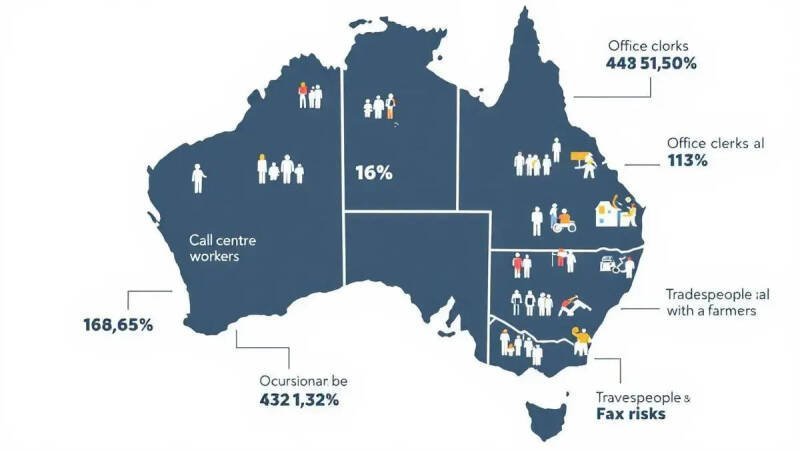
A new study in Australia has mapped the potential impact of artificial intelligence (AI) on 358 different occupations. The findings paint a picture of a rapidly changing job market, where some roles are significantly more vulnerable to automation than others.
According to the report, clerical and telemarketing roles face the highest risk of being displaced by AI. These jobs typically involve repetitive tasks and data processing, areas where AI excels. The increasing sophistication of AI-powered tools means that many of these functions can now be performed more efficiently and cost-effectively by machines.
On the other end of the spectrum, trades and farming occupations appear to be relatively safe from immediate AI disruption. These sectors often require manual dexterity, problem-solving skills in unpredictable environments, and direct human interaction, all of which are challenging for AI to replicate.
This report is crucial for several reasons. First, it provides valuable insights for individuals considering their career paths. Understanding the potential impact of AI on different occupations can help people make informed decisions about their education and training. Are your skills future proofed? Should you retrain?
Secondly, it highlights the need for proactive government policies and initiatives to support workers who may be displaced by AI. This includes providing access to retraining programs, investing in education in emerging technologies, and exploring alternative employment models.
Finally, this report sparks an important conversation about the future of work in an age of rapid technological advancement. It encourages us to consider how we can harness the power of AI while ensuring a fair and equitable transition for all workers.
In our opinion, the findings of this report are not surprising, but they serve as a stark reminder of the accelerating pace of AI development. The vulnerability of clerical and telemarketing roles has been predicted for some time, but the speed at which AI is now advancing suggests that the impact could be more profound and rapid than previously anticipated.
The relative safety of trades and farming is also consistent with our understanding of AI's current limitations. However, it is important to note that even these sectors are not entirely immune to disruption. AI-powered agricultural technologies and automated construction equipment are already beginning to change the way these industries operate.
This could impact future generations in career planning; it will be vital to focus on skills that AI struggles with, like creative thinking, problem-solving and human interaction.
Looking ahead, the impact of AI on the Australian job market is likely to intensify. As AI technology continues to evolve, more and more occupations will become susceptible to automation. This will require a fundamental rethinking of education, training, and social safety nets.
We anticipate a growing demand for workers with skills in AI development, data science, and other emerging technologies. However, it is also crucial to invest in programs that help workers adapt to changing job requirements and transition to new roles. It's vital to develop skills that complement AI rather than compete with it.
Furthermore, policymakers will need to address the potential for increased income inequality and social disruption as a result of AI-driven job displacement. This could involve exploring new models of social support, such as universal basic income, and implementing regulations to ensure that the benefits of AI are shared more broadly.
Ultimately, the successful integration of AI into the Australian economy will depend on our ability to proactively address the challenges and opportunities that it presents. A collaborative effort involving government, businesses, and individuals is essential to ensure a future where AI empowers workers and creates a more prosperous and equitable society for all.