Giant Black Holes on Collision Course: A Cosmic Event in the Making
Two supermassive black holes are predicted to collide within the next century! Learn about this rare cosmic event, its implications, and what scientists are doing to prepare.
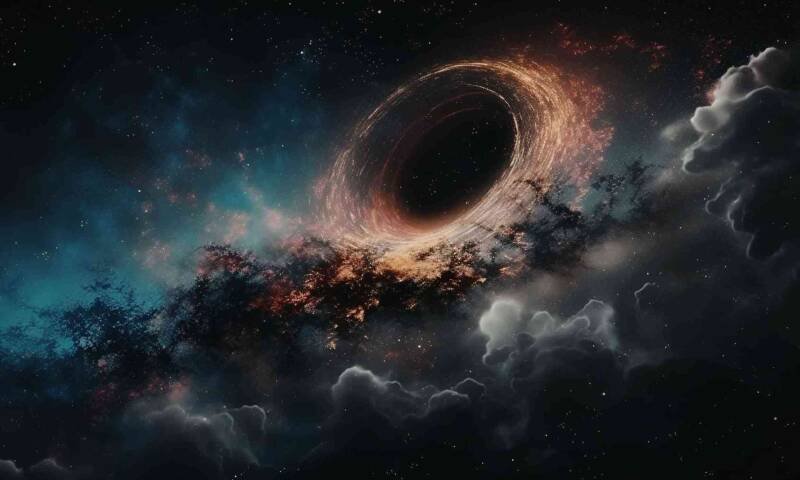



Two supermassive black holes are predicted to collide within the next century! Learn about this rare cosmic event, its implications, and what scientists are doing to prepare.
Get ready for a cosmic spectacle! Astronomers have discovered two supermassive black holes spiraling towards each other, and they predict a collision within the next 100 years. This event, taking place in the distant galaxy Markarian 501, is a once-in-a-lifetime opportunity to study the final stages of black hole mergers.
Black holes are regions in space where gravity is so strong that nothing, not even light, can escape. They are formed from the remnants of massive stars that have collapsed under their own gravity. Supermassive black holes, like the ones involved in this impending collision, reside at the centers of most galaxies.
The team of astronomers made this discovery by analyzing signals from Markarian 501, a galaxy known for its active galactic nucleus (AGN). AGNs are supermassive black holes actively feeding on surrounding matter, emitting huge amounts of energy in the process. By studying these signals, they were able to identify the presence of two black holes locked in a gravitational dance.
This discovery is significant for several reasons:
The detection of two supermassive black holes on a collision course is a testament to the advancements in astronomical observation techniques. The fact that we can now predict these events with increasing accuracy opens up exciting possibilities for future research.
In our opinion, the most significant aspect of this discovery is the potential to study gravitational waves. These waves are notoriously difficult to detect, but a black hole merger of this magnitude should generate a strong signal. This could revolutionize our understanding of gravity and the universe.
Scientists are already preparing to observe the collision using a variety of telescopes and instruments. This includes ground-based observatories, space-based telescopes, and gravitational wave detectors like LIGO and Virgo.
This could impact our knowledge of the universe. Future observations of the event could reveal:
While 100 years may seem like a long time, in astronomical terms it's practically around the corner. We anticipate significant advances in our understanding of black holes and galaxy evolution as we approach this cosmic collision.