Caste Panchayat Diktats Unconstitutional: Rajasthan HC Ruling Explained
The Rajasthan High Court declares caste panchayat diktats unconstitutional. Learn about the ruling, its implications, and future outlook for social justice in India.



The Rajasthan High Court declares caste panchayat diktats unconstitutional. Learn about the ruling, its implications, and future outlook for social justice in India.
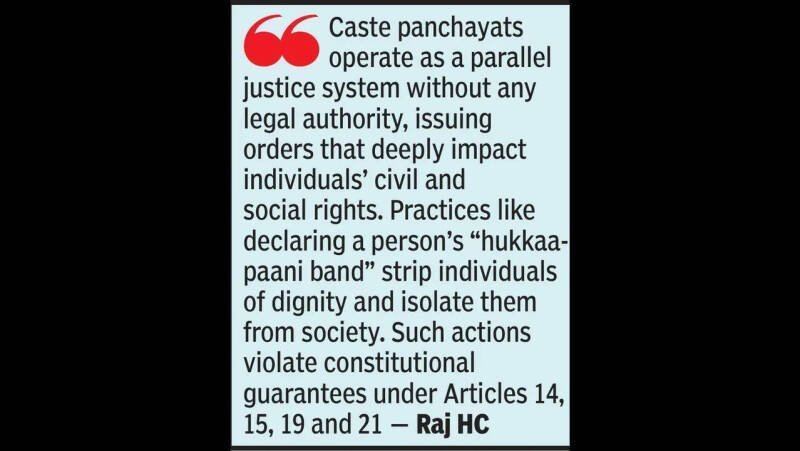
In a landmark ruling, the Rajasthan High Court in Jodhpur has declared the diktats (orders or decrees) issued by self-proclaimed caste panchayats (village councils based on caste) as unconstitutional. The court has directed the Rajasthan government to frame a law to curb the practice of social boycott, often enforced by these panchayats. This is a significant step towards safeguarding individual rights and promoting social justice.
Caste panchayats are traditional social organizations that operate primarily in rural India. They are often comprised of elders from a specific caste within a village or region. Historically, they played a role in resolving local disputes and maintaining social order. However, in recent times, many have been accused of overstepping their boundaries and issuing edicts that violate fundamental human rights. These edicts can include social boycotts, fines, and even punishments for individuals who transgress perceived caste norms.
The High Court's order explicitly deems the practice of social boycott enforced by these caste panchayats as illegal and unconstitutional. The court emphasized that these diktats often infringe upon individual liberties and are contrary to the principles of equality enshrined in the Indian Constitution. The court further directed the state government to enact legislation that specifically criminalizes social boycott and provides legal recourse for victims of these practices.
This ruling is a crucial victory for social justice and individual rights in India. Caste-based discrimination remains a deeply entrenched problem in many parts of the country, and caste panchayats often perpetuate and reinforce this discrimination. By declaring their diktats unconstitutional, the Rajasthan High Court has sent a clear message that these practices will not be tolerated. This ruling could set a precedent for other states to follow suit and enact similar legislation to protect vulnerable populations from social ostracization and injustice.
In our opinion, this is a much-needed intervention by the judiciary. While caste panchayats may claim to be preserving tradition and social order, their actions often result in the blatant violation of fundamental rights. The practice of social boycott is particularly harmful, as it can isolate individuals from their communities, deny them access to essential services, and even endanger their lives. The High Court's directive to the Rajasthan government to frame a law against social boycott is a proactive step towards creating a more just and equitable society. The success of this initiative, however, will depend on the effective implementation of the new law and the willingness of local authorities to enforce it. This could impact how caste related laws are viewed across the country.
The future outlook for this issue is complex. While the High Court's ruling is a positive development, overcoming deeply ingrained social attitudes and practices will be a long and challenging process. Several factors will determine the success of this initiative:
This ruling could have a ripple effect across India. It highlights the need for a nationwide dialogue on the role of traditional social institutions and the importance of upholding constitutional principles. If implemented effectively, this ruling could pave the way for a more just and equitable future for all citizens of India.